

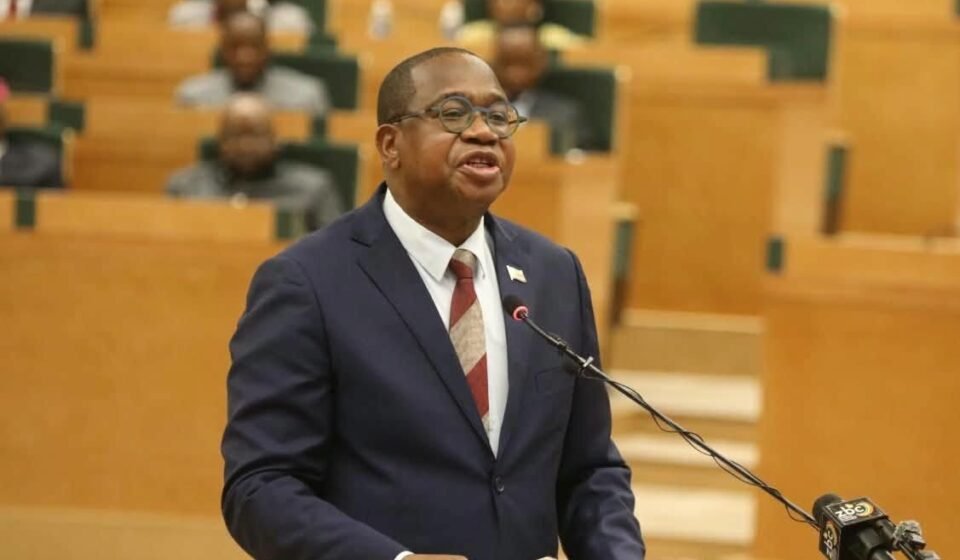
Mthuli Ncube Full 2027 Budget Presentation
Finance and Economic Development Minister Professor Mthuli Ncube presented the 2027 National Budget to Parliament this week. The theme is “Accelerating Economic Transformation and Building Resilience to Climate Change and Global Shocks.” The budget sets out the fiscal strategy for the coming year and the medium term. It builds on macroeconomic stability to widen inclusive growth.
Global recognition for the reform agenda
Minister Ncube opened by pointing to international recognition of Zimbabwe’s reforms. First, the World Bank Group removed Zimbabwe from its fragility classification on 1 July 2026. Second, the BRICS New Development Bank admitted Zimbabwe as a borrowing member in July 2026. Third, the UN elected Zimbabwe a non-permanent member of the Security Council for 2027 to 2028.
He then thanked President Dr. Emmerson Mnangagwa and the two Vice Presidents. He also thanked Cabinet colleagues, parliamentary committees, business, civil society and development partners for their input.
A risky global and domestic backdrop
The Minister warned that the budget faces a difficult environment. Recurring El Niño-induced drought is the biggest threat, and a “Super El Niño” is expected to hit agriculture and the wider economy. In addition, geopolitical tensions, tighter external financing and global trade fragmentation add pressure. Energy and food prices also remain high. “Building resilience,” he said, “is a national imperative.”
Globally, the IMF expects growth to slow to 3.1% in 2026. It then projects a recovery to 3.4% in 2027, driven by investment in artificial intelligence. That investment should offset disruption from the Middle East conflict. Meanwhile, sub-Saharan Africa should grow 4.5% in both years. SADC growth is projected at 3.2% in 2026 and 3.1% in 2027.
The domestic economy
Zimbabwe’s growth record stands out in the region. The economy has grown 33.6% cumulatively since the COVID-19 period, to the end of 2025. By comparison, the SADC average is 17.3% and the sub-Saharan average is 22.6%. In 2025 alone, growth reached 8.3%. That was the fastest in SADC and the second fastest in Africa.
For 2026, Treasury projects growth of 5%. As a result, the economy should reach about US$66 billion, more than triple its 2019 size of US$21 billion. Growth in the first nine months was 4.8%, led by agriculture, manufacturing, and wholesale and retail trade. Gross national income per capita is about US$4,100, which ranks seventh in Africa. By size, however, the economy ranks fourteenth.
Looking ahead, drought risks will slow growth to 3.5% in 2027. Treasury then expects a rebound to close to 6% in 2028. Growth should moderate to slightly above 5% in 2029.
Inflation and the external position
Prudent fiscal and monetary policy has kept prices stable. Annual inflation averaged 4% in the first ten months of 2026, below the SADC average. Treasury expects it to stay in single digits in 2027 in both currencies.
The external position is also strong. Foreign currency receipts rose 33.7% to US$15.9 billion between January and September 2026. The current account surplus should exceed US$3.5 billion this year, up from US$2.1 billion in 2025. It should then ease to US$3.4 billion in 2027. This marks seven successive years of surplus.
Diaspora remittances are growing fast as well. They rose 39.9% to US$2.5 billion in the first nine months of 2026. Treasury projects they will pass US$3.2 billion this year and reach US$3.4 billion in 2027. In 2020, by contrast, they stood at US$1.2 billion.
The financial sector
The Minister described the financial sector as safe and sound. Banks are adequately capitalised, and non-performing loans stand at 3%. The international benchmark is 5%. Moreover, US dollar deposits have grown from US$700 million in 2018 to US$5.5 billion in mid-2026.
Stock markets are performing well too. Investors continue to use the ZSE and VFEX. In July 2026, Treasury also launched the Zimbabwe Entrepreneurship Exchange (ZEX). It targets capital raising for small and medium enterprises.
Public finances and debt
Domestic resource mobilisation has improved sharply. Revenue collections have risen 316.7%, from US$2.8 billion in 2019 to a projected US$11.6 billion by the end of 2026. Consequently, the budget has grown 263.1% to a projected US$10.2 billion.
In the first five months of the year, revenue reached ZiG224.7 billion against spending of ZiG188.7 billion. Treasury used the revenue windfall to clear arrears and service debt. It also built buffers against the expected drought.
Public and publicly guaranteed debt stood at ZiG594.1 billion at the end of September 2026. That compares with ZiG566.8 billion at the end of 2025. External debt makes up ZiG331.2 billion, or 55.7%. Domestic debt makes up ZiG262.9 billion, or 44.3%. In US dollar terms, total debt is US$22.2 billion, or 33.4% of GDP. External debt accounts for US$12.4 billion and domestic debt for US$9.8 billion.
The 2027 fiscal framework
Treasury built the 2027 budget on a framework that consolidates recent gains. The key numbers are:
- Revenue: ZiG349.5 billion (about US$12.5 billion), or 18.1% of GDP.
- Expenditure ceiling: ZiG358.3 billion (about US$12.8 billion), or 18.6% of GDP.
- Drought contingency: ZiG10.9 billion (about US$400 million), financed from 2026 buffers.
- Deficit: a manageable 0.5% of GDP.
Demand far exceeded supply during consultations. Ministries, departments and agencies submitted bids worth ZiG974 billion. That is almost three times what the economy can support.
Industrialisation and mining
Industrialisation is a core priority. Treasury allocated ZiG614 million to the Ministry of Industry and Commerce. In addition, a new local content rule starts on 1 January 2027. Government, mining companies and large entities must then source at least 15% of their inputs locally, where capacity exists.
Mining policy will also tighten. Government will strengthen restrictions on exporting unprocessed raw minerals. At the same time, it will promote local processing. The Ministry of Mines and Mineral Development receives ZiG986.2 million for exploration and the Mining Cadastral Information Management System.
Infrastructure, energy, water and housing
Transport and Infrastructure Development receives ZiG10.8 billion to improve roads, rail, air and inland water links. Energy and Power Development receives ZiG1.2 billion. The country has now gone over 300 days without load shedding. Next, the ministry will diversify generation away from hydro, manage demand and upgrade the grid.
For water, the budget provides ZiG4.8 billion. The Kunzvi-Musami and Gwayi-Shangani dams remain the top priorities. Government will also keep funding smaller dams and borehole drilling. Finally, housing receives ZiG1.6 billion for houses, serviced stands and institutional buildings.
Agriculture, climate and tourism
Government has adopted a six-pillar drought response. It covers grain reserves, climate-smart agriculture, integrated financing and insurance, livestock measures, imports, and early warning systems with irrigation. So far, GMB has bought 365,000 tonnes of grain toward a reserve target of 600,000 tonnes. Government also paid a US$3.4 million premium to the African Risk Capacity drought insurance scheme.
The allocations follow this strategy. Agriculture, Mechanization and Water Resources Development receives ZiG27.6 billion. Lands and Rural Development receives ZiG2 billion. Environment, Climate and Wildlife receives ZiG702.3 million, including ZiG136.8 million for the Meteorological Services. Tourism and Hospitality receives ZiG570 million.
Education, technology and skills
Education takes a large share of the budget. Primary and Secondary Education receives ZiG47.7 billion, and Higher and Tertiary Education receives ZiG15 billion. ICT receives ZiG1 billion to improve connectivity, lower costs and support e-government. Skills Audit and Development receives ZiG330 million.
Youth, sport and the creative industry
Treasury wants to create jobs through the creative economy. Therefore, Youth Empowerment receives ZiG1.9 billion. Sport, Recreation, Arts and Culture receives ZiG1.3 billion. Both ministries will support national identity, social cohesion and economic transformation.
Health and social protection
Health receives ZiG35.5 billion for staff, equipment and facilities. Public Service, Labour and Social Welfare receives ZiG21.5 billion. This funds cash transfers, food security, disability support and livelihood programmes. In addition, the budget expands the list of assistive devices that enter duty-free for people with disabilities.
Other social allocations follow. War veterans’ affairs receives ZiG1.9 billion. Women’s Affairs, Community, Small and Medium Enterprises Development receives ZiG1.5 billion.
Devolution, governance and security
Local Government and Public Works receives ZiG5.3 billion. In line with the Constitution, a further ZiG17.5 billion goes to devolution programmes. Foreign Affairs and International Trade receives ZiG4.3 billion. Information, Publicity and Broadcasting Services receives ZiG580.6 million to finish the digital broadcasting migration. Economic Development and Investment Promotion receives ZiG2.2 billion.
On justice and security, Justice, Legal and Parliamentary Affairs receives ZiG8.9 billion. Defence receives ZiG23.4 billion, and Home Affairs and Cultural Heritage receives ZiG21.8 billion. Parliament receives ZiG4.2 billion, and the Auditor-General receives ZiG854.6 million.
Independent institutions
Treasury also funded the independent commissions. The Public Service Commission receives ZiG11.9 billion. The Judicial Service Commission receives ZiG1.7 billion. The National Prosecuting Authority receives ZiG656.4 million, and the Zimbabwe Electoral Commission receives ZiG628.2 million. The Anti-Corruption Commission receives ZiG328 million. Smaller allocations go to the Human Rights Commission (ZiG294.5 million), the Council of Chiefs (ZiG291.7 million), the Land Commission (ZiG284.6 million), the Gender Commission (ZiG223.8 million) and the Media Commission (ZiG214.8 million).
Budget credibility
Treasury will tighten spending discipline. It will no longer tolerate projects launched outside the approved budget, and it will strictly enforce the Public Finance Management Act. Furthermore, ministries must send all contracts above US$2 million, or the equivalent, to Treasury before signing. Treasury Circular No. 10 of 2025 sets this rule.
Tax measures: no new taxes
The Minister stressed that the budget introduces no new taxes and no increases in existing taxes. Instead, it offers relief and some fine-tuning:
- Personal income tax: The threshold rises from US$100 to US$150 (or the ZiG equivalent) from 2027, and the tax bands adjust accordingly.
- IMTT: The rate on ZiG transactions falls from 1.5% to 1.25%. The rate on foreign currency transactions falls from 2% to 1.75%. Government will forgo about US$120 million in revenue.
- Electric vehicles: Customs duty drops from 25% to 10%.
- Mobile phones: Customs duty drops from 25% to zero.
- Fertiliser manufacturing: A duty rebate on raw materials, intermediate inputs and equipment applies from 1 November 2026.
- Vehicle assembly: Government suspends customs duty on SKD kits for approved local assemblers from 1 December 2026. The kits cover motorcycles, tricycles, trucks and electric commercial vehicles.
- Cigarettes: A specific excise of US$15 per 1,000 sticks replaces the hybrid regime from 1 January 2027. The old regime combined 25% ad valorem duty with US$5 per 1,000 sticks.
Conclusion
Minister Ncube concluded that prudent fiscal policy and the Reserve Bank’s monetary policy have anchored macroeconomic stability. He said the country must protect these “hard-won gains.” He also urged businesses to invest in new equipment, modernisation and digital infrastructure, including automation and AI.
Finally, he tabled the supporting documents alongside the budget. They include the Budget Statement, the Blue Book, the Finance Bill, the Appropriation Bill and the public debt report. They also include the 2027 Infrastructure Investment Program, the Citizens Budget, the Fiscal Risk Statement and the National Agenda Budget Statement.