

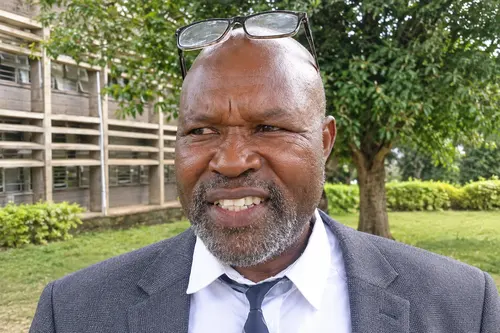
A Chief Under Repeated Scrutiny: The Controversies Around Chief Murinye
Story By Staff Reporter
Chief Murinye, born Ephias Munodawafa, has faced a string of allegations of abuse of power. Some have been tested in court and others have not. He has denied wrongdoing in the matters where he has responded, and he has not been convicted of any offence in the cases covered here.
Chief Murinye of Masvingo Rural is one of Zimbabwe’s most outspoken traditional leaders. He is also one of the most frequently accused of using his office for private ends.
The graduation party levy
The latest controversy involves a fundraising drive for his private graduation party. Village heads told the Masvingo Mirror, anonymously for fear of reprisals, that they were ordered to raise US$20 each and were warned that failure would attract a fine. They said villages were also expected to contribute US$15 each for transport to deliver the money.
The chief confirmed the contributions but said villagers decided on them voluntarily. Headman Chibwe also confirmed the US$20 figure and said there were no consequences for non-payment. The Ministry of Local Government said no law or policy lets chiefs demand money from villagers for private matters. Senior lawyer Aleck Muchadehama called it fleecing the poor, with no legal or moral basis.
The report noted it was unclear which graduation was being celebrated, since his last known one was a law degree in 2017. The headline put the target at US$6,500, but the body of the article says at least US$5,950 would be raised.
The Riverton Academy dispute
The most heavily litigated episode concerns Riverton Academy Extension, a private school in the Murinye/Machingura area.
- The standoff. The Zimbabwean reported that witnesses said the chief ordered parents to take their children home and insisted the school would not open, because its owner, Philimon Mutangiri, had not sought his permission to build it. Another report said he parked a government-issued Isuzu with no number plates across the access road, causing kilometre-long traffic queues.
- Interdict. Justice Josephine Zisengwe of the Masvingo High Court granted an urgent interim order barring him from blocking access to the school, finding that his actions amounted to unlawful self-help rather than a lawful exercise of authority. The chief argued the school was built without his authority and without council approval.
- Summons quashed. In July 2026, Justice Christopher Dube-Banda quashed a summons the chief had issued against Mutangiri, ruling that the chief was disqualified from hearing the matter. The headline summed it up: you cannot be judge and complainant.
- The criminal case. Mutangiri accused the chief of extortion. The State alleged he demanded electricity for his homestead and free, indefinite schooling for his children. He denied this, and his lawyer argued the prosecution was retaliation for questioning the school’s legality. The Masvingo Regional Court acquitted him after his lawyer applied for discharge at the close of the State’s case. The magistrate also refused to substitute an alternative disorderly conduct charge.
The acquittal matters. A court has found no case for him to answer on extortion, and any fair account must say so. The civil rulings are a separate matter, because the High Court judgments criticised the way he used his authority in the dispute.
Earlier allegations
According to the Pindula profile of the chief, the pattern goes back some years. It records that in December 2020 a man named Charles Mathe sued him for US$41,400, claiming he worked for the chief for four years without pay. The chief said he never employed Mathe. It also records that in October 2020, villagers accused him of forced labour and of denying some of them food aid. These are allegations. This article has not found any court outcome for them.
Midweek Watch also reported that he fired gunshots at mourners at a funeral in Boroma Village as a show of power. The provincial chiefs council chairman defended him in that report. I found no follow-up on the outcome, so treat it as a single unverified report.
Questions of accountability
Traditional leaders hold real power over land, disputes and local levies, and rural residents have few ways to challenge them. Chief Murinye also has defenders. In 2021 he publicly accused powerful politicians of abusing government farming inputs, and fellow chiefs said he was airing frustrations shared by many of his people. His supporters argue that scrutiny of him is politically motivated. His critics say his record shows a leader treating his office as a personal tool.
The courts have ruled that he cannot enforce his own grievances through self-help. They have not convicted him of any crime. Whether the graduation levy is voluntary, as he says, or coerced, as village heads allege, is a question for independent investigation, and the Ministry of Local Government has so far only said no law allows such demands.