

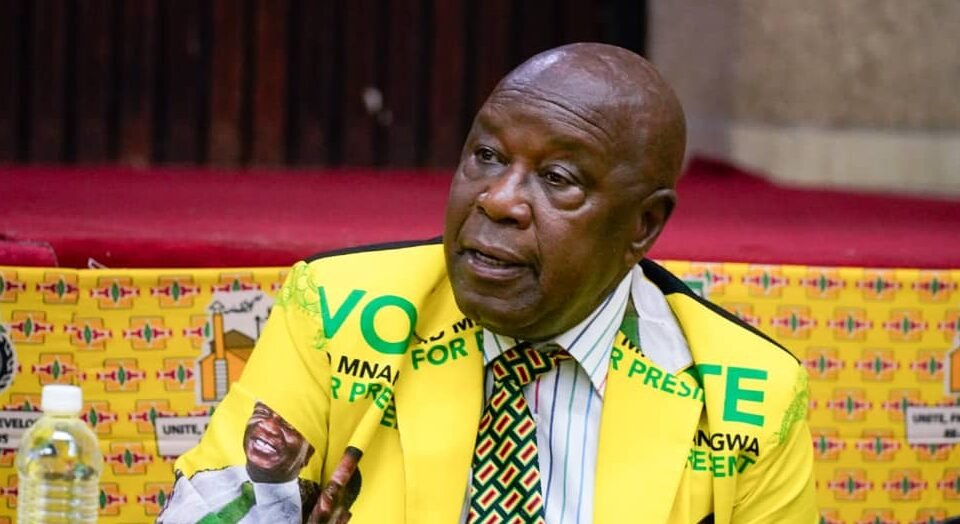
Mutsvangwa Defends ED’s US Ties, Denies Party Role in Vendor Evictions
Story By Yvette Choga
Harare, September 24, 2026 — Addressing journalists at ZANU-PF headquarters today, party spokesperson Christopher Mutsvangwa used a wide-ranging briefing to defend President Emmerson Mnangagwa’s record and push back against what he called “detractors” spreading a false narrative about Zimbabwe’s standing on the world stage.
UN General Assembly and US Relations
Mutsvangwa said President Mnangagwa is in New York for the UN General Assembly partly to thank member states that backed Zimbabwe’s bid for a non-permanent seat on the UN Security Council. According to Mutsvangwa, roughly 182 countries voted in Zimbabwe’s favor — a margin he said was far larger than the next-closest candidate, which he put at around 113 votes. Zimbabwe is due to take up one of the Council’s ten elected seats. Reuters and other wire services have reported on Zimbabwe’s Security Council candidacy; the precise vote tallies cited by Mutsvangwa could not be independently confirmed at time of publication.
He also pointed to what he described as a recent US decision granting Zimbabwe access to a sugar export quota, calling it evidence of warming ties with Washington under the Trump administration. He contrasted this with tensions during past Democratic administrations, which he blamed for the 2001 ZIDERA sanctions legislation. Mutsvangwa said efforts are underway in the US legislature to repeal ZIDERA, naming Republican Congressman Marlin Stutzman as an ally in Washington — though he did not cite a specific bill number, and no such repeal effort could be independently verified at time of publication.
He further claimed that recent US engagement with Mozambique — including what he described as a $4.7 billion American investment in the Cabo Delgado gas fields — signals a broader regional shift in Washington’s Africa policy that he said benefits Zimbabwe as well. Major US and Western investment in Mozambique’s gas sector has been reported by other outlets; the specific $4.7 billion figure cited by Mutsvangwa, and his characterization of it as the largest American investment in Africa in 300 years, could not be independently verified from this briefing alone.
Courting Afrikaner Business Networks
A significant portion of the briefing focused on outreach from prominent South African-born business figures. Mutsvangwa named Elon Musk, Peter Thiel and others of Afrikaner descent, describing them as lobbying informally in Washington on Zimbabwe’s behalf, including through the Hudson Institute think tank. He said the government has hosted several such figures, along with South African traditional leaders who he said visited Harare to distance themselves from xenophobic sentiment in South Africa.
These are Mutsvangwa’s own characterizations of informal, undocumented lobbying activity; none of the individuals or organizations named have publicly confirmed the specific role described.
Dismissing Talk of Internal ZANU-PF Divisions
Mutsvangwa dismissed suggestions of a rift within the party’s leadership, describing critics who invoke the liberation-war legacy against Mnangagwa as marginal figures with no real following. He cited Vice President Constantino Chiwenga’s recent trip to China, where Chiwenga met investors in the Zhejiang province, as evidence of party unity — a characterization that reflects Mutsvangwa’s own account of the trip’s purpose.
Street Vendor Evictions and Informal Settlements
Asked by reporters about the removal of street vendors in Harare and the demolition of informal housing settlements — actions some residents have linked to ZANU-PF figures — Mutsvangwa said urban regulation is the responsibility of local councils, not the party, and denied any connection between the crackdowns and public reaction to the recent constitutional amendment. He argued that orderly cities are necessary to attract investment, citing Shenzhen, Dubai and Mumbai as models he said Harare should aspire to.
Civil society groups and opposition figures have previously disputed the government’s characterization of such evictions, arguing they disproportionately affect the urban poor with little consultation or resettlement support — a perspective not addressed by Mutsvangwa in today’s briefing.
Context
The briefing came ahead of ZANU-PF’s party conference next month in Chinhoyi, and amid ongoing debate — domestically and internationally — over Zimbabwe’s political trajectory following constitutional changes to presidential term provisions. Figures and claims attributed to Mutsvangwa in this article reflect statements made by him at the briefing; independent verification of specific investment totals, vote counts, and the status of US legislative action on ZIDERA was not available at time of publication.