

“Operation Chenesa” Clears Billboards, While Basic Services Lag, Residents Say
Story By Godknows Mwayera
Based on public reactions to a City of Harare announcement.
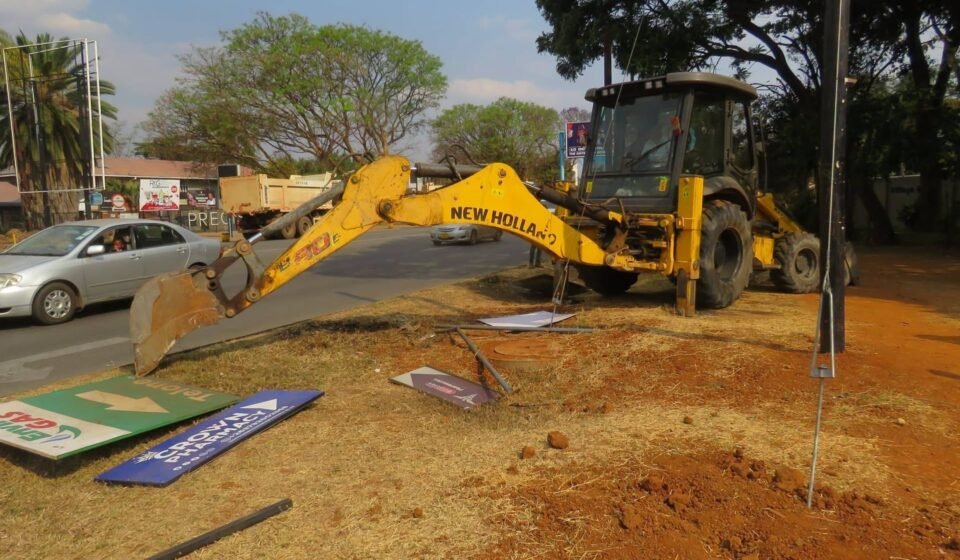
The City of Harare’s Department of Works has intensified its clean-up campaign along Borrowdale Road, pulling down illegally erected billboards and unauthorised signage as part of the broader “Operation Chenesa Harare” initiative. According to the local authority, the exercise—which began at Helensvale and is progressing toward Sam Levy’s Village—targets structures at road junctions and intersections that obstruct motorist visibility and pose safety risks.
News of the demolitions, shared via the City of Harare’s official Facebook page, drew a wide range of reactions from residents in the comments section.
Why the City Says Action Was Necessary
Municipal officials argue that many of the removed billboards were erected without proper authorisation and had become genuine hazards. Positioned near intersections, several structures reportedly blocked sightlines for drivers. From a road-safety standpoint, the city frames the demolitions as a necessary, if disruptive, corrective measure.
Residents Welcome the Safety Rationale
Several commenters expressed support for the initiative, particularly with the rainy season approaching. One resident emphasized the importance of redirecting municipal energy toward drainage maintenance ahead of the rains, noting that functional stormwater systems are essential to protecting roads from damage. Others pointed directly to the accident risk posed by obstructive signage, agreeing that visibility at junctions needed to be restored.
Frustration Over Uneven Enforcement
Not all reactions were positive. Several commenters questioned why cleanup efforts appeared concentrated in certain areas while other parts of the city—including sections of the central business district—seemed neglected. One comment referencing the Copacabana rank area suggested that some commercial hubs continue to suffer from poor conditions, including congestion tied to fuel queues, despite the visible demolition drive elsewhere.
Other residents raised concerns, in a mix of English and Shona, about illegal dumping and uncollected refuse in high-density suburbs, suggesting that enforcement resources might be better directed toward sanitation problems in those communities.
Calls for Broader Service Delivery
A recurring theme among critical commenters was the perception that demolition work is proceeding faster than investment in basic services. Residents cited ongoing challenges including:
- Inconsistent or unavailable running water in residential areas
- Deteriorating road conditions, from potholes to unpaved dust roads
- Sewage system failures, with some describing sewage flowing openly in places
- Clinics and health facilities reportedly not functioning at full capacity
For these residents, the underlying message was that infrastructure and service delivery should be prioritised alongside, or ahead of, enforcement actions against informal signage and structures.
Some Commenters Question Motives
A number of comments went further, alleging that enforcement decisions might favor established businesses over small, informal traders. These posts suggested that individuals connected to government may have personal business interests that could influence which structures are targeted. It’s important to stress that these are unverified allegations made by anonymous social media commenters, not claims supported by evidence presented in this article or confirmed by any investigation. No specific individuals or businesses are named or identified here, and readers should treat such claims with appropriate skepticism unless corroborated by credible reporting or official inquiry.
A Specific Safety Concern Flagged
At least one commenter identified the Highglen Road and Mukonono Street intersection in New Marimba as an accident-prone area requiring the city’s attention. This is a single resident’s report shared on social media and has not been independently verified against official accident data.
The Bigger Picture
Taken together, the online reaction illustrates a familiar tension in urban governance: enforcement actions framed around safety can still generate public frustration when residents feel that more fundamental service delivery issues—water, sanitation, roads, and healthcare—remain unresolved. Whether the City of Harare addresses these broader concerns alongside its current enforcement drive may shape how residents view the campaign going forward.

Thank God for your help and passion 💜 heart for the program that is being used by the relevant authorities. Everyone should support that Many thanks for that plan