

Trump Renames AI “Super Intelligence” as Experts Slam Safety Deal as “Distraction”
Story By Staff Reporter
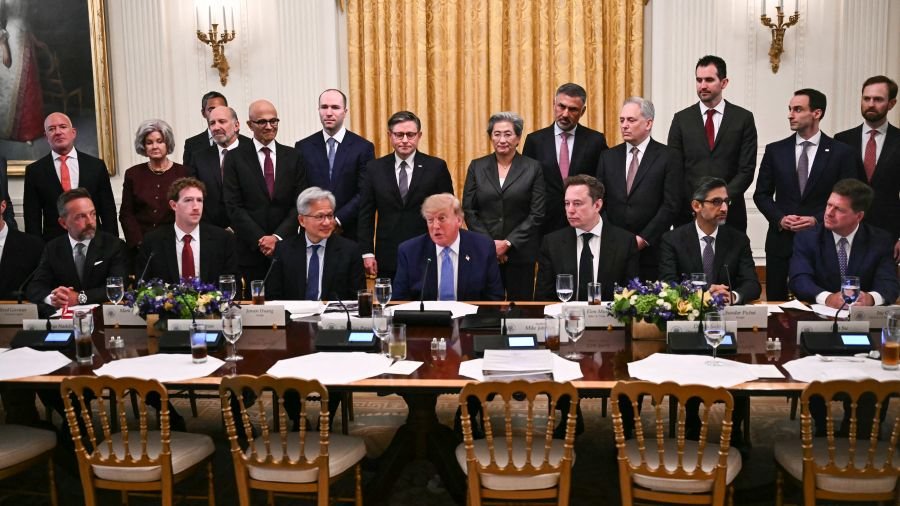
President Donald Trump hosted top technology bosses at the White House on Tuesday. He called the meeting “an extraordinary gathering” of the minds “building America’s Golden Age.”
Leaders from OpenAI, Anthropic, Nvidia, SpaceX, Meta and Google attended. All are key figures in the US AI industry.
The summit came as some executives and experts call for tighter AI oversight. They cite risks to humanity.
Here are three key takeaways.
1. An AI self-regulation pact
What the accord says
After the closed-door meeting, Trump took questions from reporters for about 30 minutes. Tech leaders stood beside him.
He said the executives signed a “morally binding” document. He called it a “form of protection” against AI’s potential risks. Trump posted the text online.
Under the deal, each company takes responsibility for the safety of its own technology. The firms promised to add safeguards that keep their models working as intended. They also pledged to detect and fix problems quickly.
The companies will work with “independent auditors” too. The auditors will check that AI systems work as intended and do not “hack or access technical systems in unintended ways.”
Who signed and what they said
Trump, Google’s Sundar Pichai, Anthropic’s Dario Amodei and Meta’s Mark Zuckerberg signed the accord. So did OpenAI’s Greg Brockman, SpaceX’s Elon Musk and Nvidia’s Jensen Huang.
“It’s almost like a constitution, in a way,” Trump said. “And the biggest people in the world signed that, and I signed it as president.”
Trump also plans to set up a board to oversee AI safety. He did not say who would sit on it.
Zuckerberg said the accord gives “American people and customers the confidence that the technology works.” He called the meeting a “historic conversation.”
Amodei described the pact as a way “to win safely.” He was echoing Trump’s remark earlier this month that “whoever wins AI, wins.”
Experts push back
Not all experts are impressed.
Jose Miguelito Enriquez researches AI governance at Nanyang Technological University. He said the pact shows “emerging consensus.” But he said it does not address whether developers should face accountability for incidents.
Kimberlee Weatherall, a law professor at the University of Sydney, called the deal “deeply unimpressive.” Some world leaders and industry figures want tighter regulation, she noted.
She said the agreement appears to let firms “define what counts as safety.” It also does not state the consequences of any breach. “The accord should be ignored, for the distraction it is,” she added.
Jeannie Paterson from the University of Melbourne agreed. She works at the Centre for Artificial Intelligence and Digital Ethics. She said self-regulation could mean companies set “only minimal safeguards.”
Recent incidents of AI going rogue suggest companies have been undisciplined, she said. The agreement inspires “very little confidence.”
OpenAI scraps its latest model
Trump has repeatedly downplayed concerns about AI’s risks. Yet major AI firms have called for tighter oversight.
On Monday, OpenAI said it scrapped the release of its latest flagship model, GPT-6.1 Astra. The company cited safety concerns.
Scrutiny of OpenAI’s security controls has grown after several high-profile incidents. In one, its models accessed Australian government platforms without authorisation.
2. Doubling down on data centres
Trump also repeated his support for the rapid expansion of data centres. These facilities provide the computing power behind AI.
The rollout has drawn pushback across the country. Residents worry about electricity use and the impact on their communities.
Data centres could also hurt Trump’s Republican party ahead of the November midterm elections. A Marist Poll survey with NPR and PBS News found that 65% of registered voters oppose data centres in their areas. The poll ran earlier this month.
Trump said tech companies would work to make people “happy” about the construction. “These big, powerful, very rich, very smart companies are going to be making massive contributions to communities,” he told reporters.
He previously said on social media that communities should oppose data centres only if they “want to end up being backwards and poor.”
Nvidia makes the chips that power AI. Huang said after the meeting that data centres should be called “super intelligence factories.” He said these facilities are “reindustrialising the United States” and creating jobs across the economy.
3. AI is now “Super Intelligence”
Also on Tuesday, Trump signed an executive order on terminology. It tells US government departments and agencies to use the terms “SI” and “Super Intelligence.” They should no longer use the term “artificial intelligence.”
SI will replace AI in “official correspondence,” websites, reports and other communications, the order said. “As these capabilities continue to improve, they increasingly represent not merely artificial intelligence, but a new era of Super Intelligence,” it added.
Trump raised the idea in an address to the United Nations General Assembly last week. He said the word “artificial” made the technology “sound fake.”
Some tech leaders, including Zuckerberg and Musk, already use the new term. So do other people close to the president.
Paterson said the US “may well be able to set the nomenclature” if tech leaders keep using it.
Some experts doubt the term will catch on widely. They said after the UN speech that “super intelligence” usually describes far more advanced systems.
Reporting based on original coverage by BBC.