

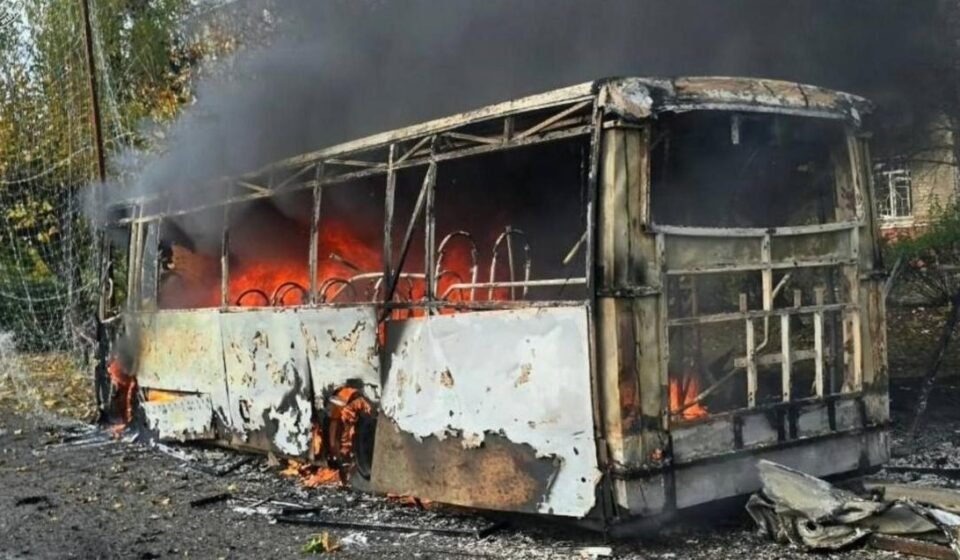
Russian strike on buses kills at least 30, say officials, as deadly attacks on Ukraine surge
Story By Staff Reporter
A Russian glide bomb attack on two civilian buses has killed at least 30 people, rescue officials say. The strike hit Kramatorsk, a city on the eastern front line.
The attack also killed three people in Bilenke, a village in the Kramatorsk community. Another 18 people were wounded, according to Donetsk regional head Vadym Filashkin. He accused Russia of targeting buses carrying passengers to kill as many civilians as possible.
Local prosecutors posted images of the burning metal shell of a bus. Debris and some of the victims lay on the road.
Kramatorsk City Council called the strike a “horrific crime committed by the Russian army against the civilian population”. It said the Russians had again hit a location where there are “absolutely no military targets”.
Zelensky promises a response
Ukraine’s President Volodymyr Zelensky said: “This strike will not go without our response.”
In a Telegram post, he said: “Russia is trying to destroy all life in Donbas, and the world needs to react to this. React harshly – exactly as the Russians deserve for all the deaths they have caused.”
Zelensky offered his condolences to the families and loved ones of the victims. He said Ukraine’s partners must provide “concrete action through new defence packages for the protection of Ukraine”.
Moscow has not yet commented on the attack.
Public transport halted
Filashkin urged anyone still in the eastern front line region to move to safer parts of Ukraine. Security has sharply deteriorated in Kramatorsk and Slovyansk, so authorities ordered all public transport to stop.
Civilian safety is paramount, he said, and “we have no right to risk the lives of passengers and drivers”.
Why Kramatorsk matters
Kramatorsk and neighbouring Slovyansk are part of a so-called fortress belt. Moscow is trying to seize it as part of Russian President Vladimir Putin’s claim to the entire industrial region of Donbas.
Donbas consists of two regions, Luhansk and Donetsk. Russia controls most of Luhansk. The Kremlin now aims to capture the remaining 20% of Donetsk that Ukraine still holds.
Moscow has often cited the “liberation” and “protection” of the predominantly Russian-speaking Donbas to justify its full-scale invasion.
For much of the war, Kramatorsk served as a logistics and supply hub for the Ukrainian military. Russian forces now attack it almost daily as they move closer to the east of the city.
Russia has launched glide bombs at both Slovyansk and Kramatorsk. Winglets on these bombs make them glide towards their target rather than simply fall. In late August, Russia fired as many as nine glide bombs at Kramatorsk in one day.
Civilian deaths surge across Ukraine
The attack follows a dramatic surge in Russian strikes across the country. According to the UN, more civilians died in Ukraine by August this year than in all of 2025.
One attack early on Wednesday destroyed a five-storey block of flats in Pryluky, east of Kyiv. It killed 22 people, including five children. Three of the children were only one year old.
UK announces new sanctions
UK Foreign Secretary Ed Miliband met Zelensky in Kyiv on Thursday. He said the Pryluky attack showed Putin’s “evil intent and evil strategy”.
Miliband announced “more sanctions on Russia, on the war machine of Putin, on the shadow fleet, on the oil companies, on the crypto, on the financing of the war”. He told Zelensky the UK would stand with Ukraine “as long as it takes for you to prevail in this conflict”.
Constant air raids on Kyiv
Russia is also launching constant air raids on the capital, and sirens ring throughout the day. Kyiv’s mayor, Vitali Klitschko, said Thursday’s attacks killed three people and injured 14 others. Two of the eight injured are in a critical condition.
The attacks force schoolchildren into shelters, shutter businesses and disrupt public transport. Strikes on Ukrainian infrastructure, particularly the energy grid, are causing power outages and even affecting the water supply. On Thursday, local water authorities warned that pressure was dropping across the city’s right bank because of power cuts.
Warnings are Ukraine’s main defence
Earlier this week, Zelensky warned of intelligence suggesting Russia plans a major onslaught. Families in Kyiv responded by heading to metro stations for shelter.
For now, such warnings are one of the only defences Ukrainians have. Interceptor missiles are in short supply around the world, so Ukraine has little chance of stopping incoming Russian ballistic missiles.
Both countries have intensified long-range strikes on each other in recent months. Russian attacks have targeted Ukrainian data centres and logistics warehouses.
Reporting based on original coverage by BBC.