

The Nyerere Trap: Zanu PF in Turmoil
Story By Staff Reporter
An extraordinary Zanu PF politburo meeting collapsed into disarray on Friday, October 9. Tensions erupted before the meeting could formally begin. A multi-layered conflict over amendments to the party constitution caused the breakdown. The amendments aim to align the party rules with the national Supreme Law.
New details point to a cocktail of factors behind the scenes. All of them feed the volatile succession battle.
Three issues behind the cancellation
Fresh information shows three contested issues forced the cancellation.
First, Vice-President Constantino Chiwenga lodged his latest protest against the proposed constitutional amendments. Second, Speaker of Parliament Jacob Mudenda erupted in a fierce outburst over the same amendments, but for a different reason. Third, legal affairs secretary Ziyambi Ziyambi tabled far-reaching proposals, particularly the Julius Nyerere precedent.
The timing made matters worse. The party’s annual conference in Chinhoyi effectively starts today.
What the Nyerere proposal means
Party leaders convened the special session to push through sweeping amendments. The changes would harmonise party rules with the national charter. They also cover next year’s elective congress, which the party will delay to 2030.
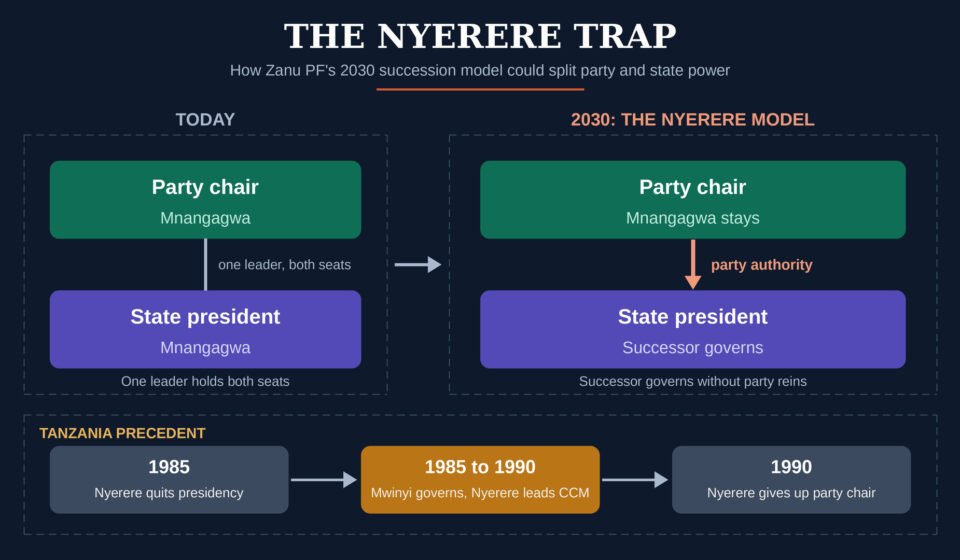
The Nyerere proposal would give Mnangagwa a soft landing in 2030. His successor would take over as State President without controlling the ruling party. The new president would therefore govern without the reins of party stewardship.
The conference programme
The annual conference runs from today until Saturday. The programme is expected to unfold as follows:
- Tuesday: politburo meeting
- Wednesday: central committee gathering
- Thursday: delegates travel to the venue
- Friday: conference and the President’s address
- Saturday: closure
- Sunday: delegates travel back
The programme could still change. If the politburo meeting to officially open the conference happens today, the schedule will shift.
Intelligence warning and factional fights
An intelligence report warned President Emmerson Mnangagwa before the cancellation. It said the session was explosive. Factions within factions have emerged. Ambitious individuals push their own agendas and interests. Others fear for their futures and battle for survival.
Mnangagwa now navigates a political minefield. He wants to keep his 2030 agenda from derailing midstream. He also wants to protect his succession plans from shipwreck.
A recent constitutional amendment process succeeded and extended his stay in office by two years. The changes also lengthened the terms of the president and parliament from five to seven years. They also shifted the election of the president from a direct vote to a vote by the legislature. The National Assembly and Senate would sit as an electoral college. Critics contest these and other far-reaching reforms.
Tagwirei and the succession race
The reforms have fuelled internal strife and instability. Billionaire Kudakwashe Tagwirei is manoeuvring to position himself to take over in 2030. The party’s constitutional proposals, particularly the Nyerere model, now redefine or threaten that generational transition.
The Nyerere precedent
Julius Nyerere stepped down as President of Tanzania in 1985. He stayed on as chairman of the ruling Chama Cha Mapinduzi (CCM) for five more years, until 1990. He kept exercising party authority during that time. Ali Hassan Mwinyi served as state president under Nyerere’s leadership and ideological tutelage. That arrangement managed the succession transition.
Reporting based on original coverage by NewsHawks.