
Post Cabinet Media Briefing 13 October 2026: Child Justice Bill, Kariba Solar and More
Story By Staff Reporter
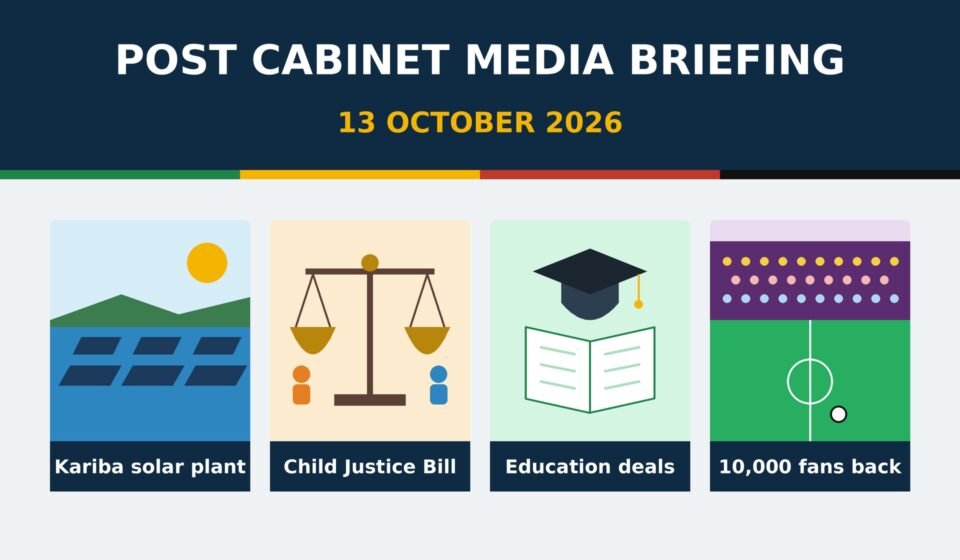
Cabinet approved the Child Justice Bill 2026 and received an update on the planned 600 megawatt floating solar power plant on Lake Kariba. The decisions were announced at the Post Cabinet Media Briefing on 13 October 2026. Ministers also answered questions on alluvial mining, weather forecasting and regional trade integration.
Kariba Floating Solar Plant Moves Towards Construction
Agriculture, Mechanization and Water Resources Development Minister Dr Anxious Jongwe Masuka updated Cabinet on the project. In December 2023, President Emmerson Mnangagwa directed government ministries to facilitate private investment in the plant. The project aims to boost hydropower generation and stabilise national power output. It will also save water during the day through solar generation and strengthen the climate resilience of the Kariba power system.
The project is valued at US$650 million. Green Grid Energy Private Limited, formerly Sunspire, is the developer. The Zimbabwe Electricity Transmission and Distribution Company (ZETDC) will be the sole buyer of the power.
At full capacity, the plant will supply electricity to three million people. It will also create 1,000 direct jobs in Kariba.
Several milestones have already been reached. Grid and technical studies, the land survey and the environmental impact assessment are complete. Regulatory licensing is also done, and the commercial agreements have been negotiated. The power purchase agreement and the transmission connection agreements were signed in 2025. Technical, regulatory and preparatory work was finalised in July 2026.
Engineering and project preparation work is now progressing well. Resources are also being mobilised for the detailed designs. The traditional groundbreaking ceremony has taken place, and the project is preparing for implementation. Government says it will keep up whole-of-government coordination and oversight so the plant is completed on time.
Child Justice Bill 2026 Approved
Justice, Legal and Parliamentary Affairs Minister Ziyambi Ziyambi presented the Child Justice Bill 2026. He did so as Chairman of the Cabinet Committee on Legislation. Cabinet considered and approved the Bill.
The Bill creates a separate criminal justice system for children in conflict with the law. It also protects children’s rights as set out in the Constitution and in regional and international instruments. In addition, it provides for provincial and district justice committees and district diversion committees. It amends the Criminal Law (Codification and Reform) Act [Chapter 9:23] on the age of criminal responsibility for a child.
Parliament had already passed the Bill in both houses, and it had been gazetted. It was then referred back so that the roles of child protection officers and diversion officers could be clearly defined. The aim was to improve coordination and remove duplication.
A thorough review followed, and nine clauses were revised. They cover guardianship where no appropriate adult is available. They also cover recommendations on releasing a detained child and the extent of the diversion officer’s role. The revised Bill places responsibility in a single office. This removes overlaps and strengthens the supervision of diverted cases.
New Education Agreements With Applied Scholastics and Korea
Cabinet also approved two memoranda of understanding on education.
The first is with Applied Scholastics International on teacher training and professional development. It will run for five years, with the option to renew. It takes effect when both parties have signed. The agreement supports government’s goal of improving the quality and relevance of education. It also aims to strengthen teacher competencies.
The second is with the Republic of Korea. It sets up cooperation in basic education between Zimbabwe’s Ministry of Primary and Secondary Education and a Korean metropolitan city office of education. Zimbabwe expects to benefit from Korea’s experience in several areas. These include teacher development, curriculum, technology, assessment systems and school infrastructure.
CAF Allows 10,000 Fans at National Sports Stadium
Sport, Recreation, Arts and Culture Minister A.N. Sanyatwe told Cabinet that Zimbabwe had appealed to the Confederation of African Football (CAF). The appeal concerned the temporary suspension of spectators at venues in Zimbabwe. Cabinet welcomed CAF’s decision to allow 10,000 spectators at the National Sports Stadium. Strict safety conditions apply, as part of a roadmap to lifting the suspension.
Ministers Answer Questions on Mining, Weather and Trade
Alluvial Mining Ban Remains
Dr Masuka said alluvial mining remains banned under Statutory Instrument 188 of 2024. The President declared a state of disaster on degraded river ecosystems through Statutory Instrument 91 of 2026. Statutory Instrument 106 of 2026 later extended it. The Mazowe River is one of the affected rivers.
The ministerial committee received 250 expressions of interest to rehabilitate degraded river sections. Contracts were awarded to 64 companies, and some of them cover the Mazowe River. He said the Inter-Ministerial Committee is now monitoring compliance with those contracts. He added that machinery in a river does not automatically mean illegal alluvial mining, because the same equipment is used for rehabilitation. Enforcement agencies have been told to uphold the law.
Early Warning Systems
A minister explained that seasonal forecasts are probabilistic. A 45 percent probability still leaves room for error, so it is too early to say the forecasts are wrong. The Foreign Affairs Minister said Zimbabwe has invested in early warning systems in almost every province. He said a recent disaster pointed to weak communication between the Meteorological Services Department and the communication platforms that warn the public.
Cabinet has therefore ordered an investigation. It will assess the country’s level of preparedness and the amount and distribution of equipment. It will also establish whether the disaster could have been avoided with better communication. [Note: the transcript is unclear on the place name, so please add it.]
COMESA Integration and Visa Reform
The Foreign Affairs Minister linked regional integration to Section 12(2) of the Constitution, which he described as requiring Zimbabwe to be Pan-African. He said Zimbabwe belongs to the African Union, COMESA, SADC and the African Continental Free Trade Area. He argued that a market of more than 640 million people in COMESA could help move Zimbabwe to a high-income economy.
He said government plans to liberalise visa regimes and automate immigration systems. Per capita income is currently about US$3,500. The target is US$4,500 well before 2030. He also said Zimbabwe will soon chair COMESA.
Another minister said the economy has grown from about US$16 billion to over US$66 billion. He credited this to value addition and beneficiation policies, saying Zimbabwe is no longer exporting raw minerals.